
My thanks to for proofing this for me.
Skirmishes in The Lord of the Rings Online are akin to smaller dungeons that have specific mechanics. While many are optional, occasionally Skirmishes form part of the Epic Questline – Moria and Mirkwood being two that spring to mind. One of the key features of Skirmishes is the ability (maybe even the necessity) to use an NPC to fight alongside you. But getting your head around how to get started with a LOTRO Skirmish Soldier can be a bit of a minefield.
Here’s my guide to help you – and likely clarify a few things to me too! So, let’s get started.
Solo Content
Just as a quick pointer, anytime I refer to Skirmishes here, I am talking about Solo ones. This is because I’ve never done a group one, nor am I likely to, so I can’t give a valid opinion. If you do group up for a Skirmish, talk to your group and see how you should spec your Soldier (and maybe your own LOTRO Gearing) before wading in.
What is a Skirmish Soldier?
Combat Roles
Your Soldier can be set up to perform any of the traditional combat roles: Tank, Melée DPS, Ranged DPS, Healer and Support. The word “Soldier” is used regardless of what role you want them to play.
This role is not set in stone either. So you can adapt your Soldier to the scenario in each Skirmish if you want to.
Personalisation
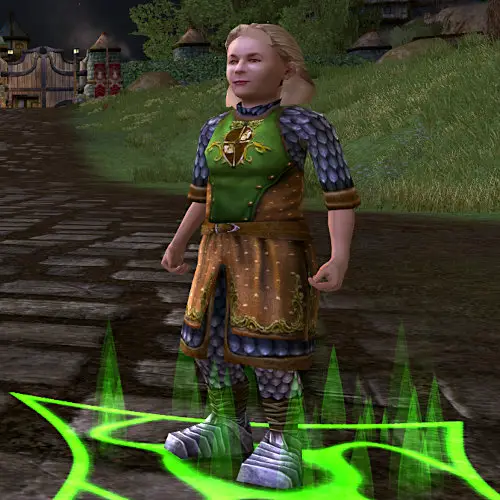
This NPC assistant is very customisable: firstly you can choose among the roles I mentioned, then you can select their in-combat abilities and other passive attributes. And lastly, there is an array of cosmetic changes you can make to truly personalise them.
Unlocking Skirmishes
If you’re new to LOTRO, then you may not yet have encountered Skirmishes, or you have just seen a prompt to take part in one.
Once you hit Level 20, you should be prompted to accept a quest called Skirmishes – Reporting In .
.
Follow this quest and speak to a Skirmish Captain, with the most likely candidate being the one just outside Bree, though there is one in Thorin’s Gates, right by Thorin’s Hall in Ered Luin too.
Skirmish Tutorial 1

You will then have two “mini Skirmishes”. The first is Thievery and Mischief, where you’ll be introduced to the idea behind Soldiers then fight alongside a basic one for a wee bit. Thievery and Mischief is a real Skirmish, but the tutorial just covers a small portion of it.
You will also face an Encounter and a Counter-Attack.
Skirmish Tutorial 2

Defence of the Prancing Pony is the second part, where an overview of combat roles is explained. These two tutorials also serve to demonstrate a Defensive Skirmish, where the previous one was Offensive.
Soldier Combat Classes
Upon exiting the tutorials, your default Skirmish Soldier will be a Man (as in a male human) Warrior. But they can become almost anything you want or need to succeed in a Skirmishes. The most important decision will be which combat class they will be.
The below screenshots are the default appearance for that class or role. Click/tap the thumbnail to view the Soldier’s full height.
Archer
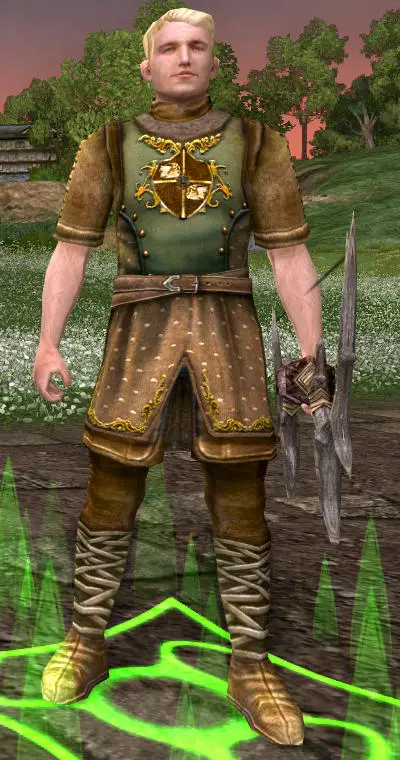
As with LOTRO Hunters, Archers are range DPS. But they’re not “harriers”, instead they focus on single targets. This may help during boss fights, for example.
Bannerguard
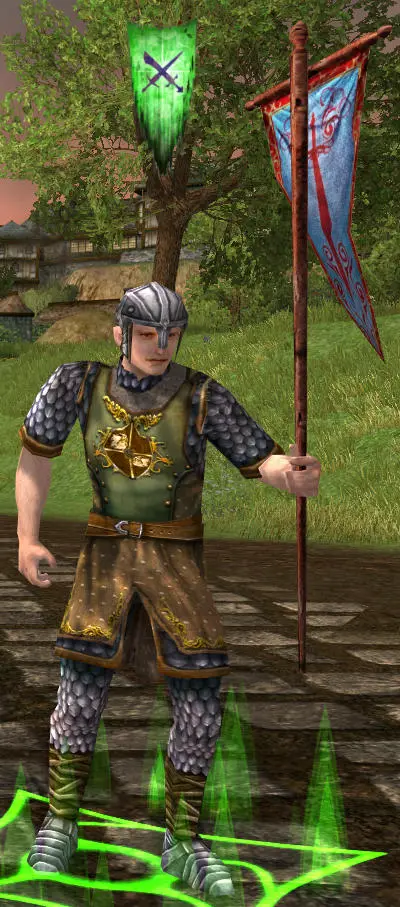
Similar to a Captain’s default companion, a Bannerguard supports you in combat. This includes buffs as well as basic combat.
They can also draw aggro away from you.
Herbalist
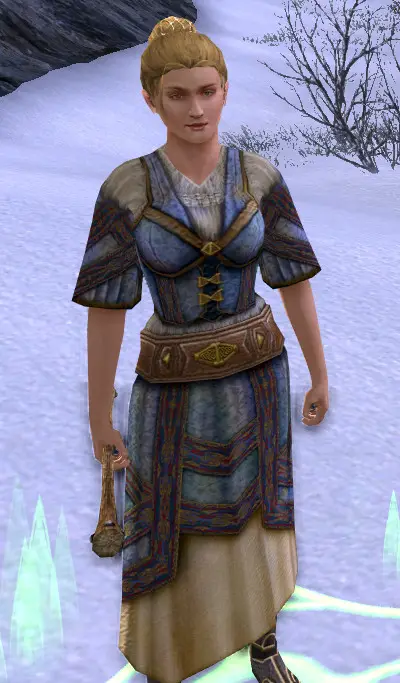
This is a “pure healer” class, so do not expect them to fight for you. You will have to protect them, though they can (and do) also heal themselves. Skills can be acquired that buff or protect you.
Protector
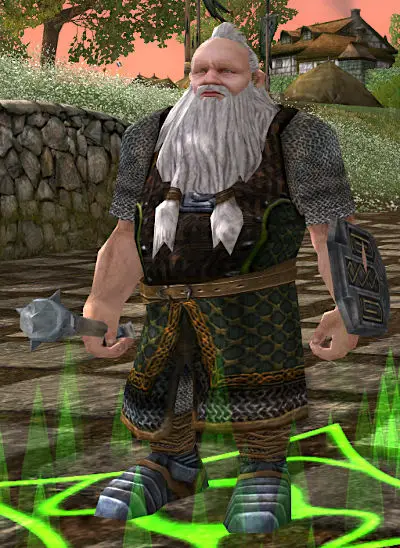
As the name implies, Protectors are tanks, sent to, well, protect.
Their damage is low, but they keep some of the heat away from you.
Sage
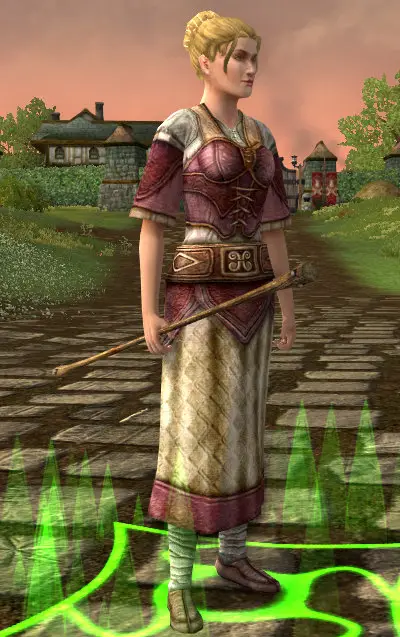
Sages are light armour, ranged DPS that focus on debuffing the enemy. Though they don’t always keep as long a range as you might like for their safety.
Warrior
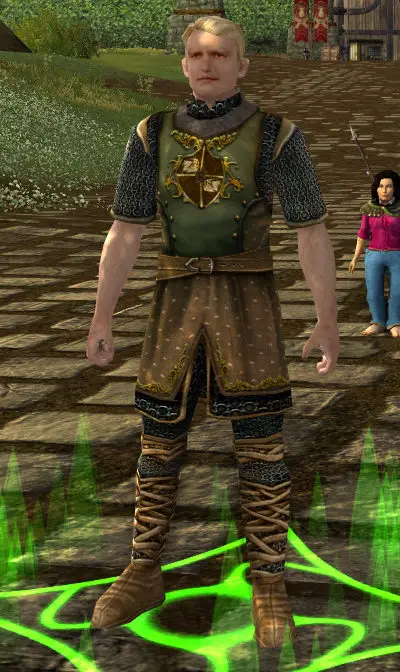
A melée, dual-wielding DPS class, and both single-target and AoE skills can be learned by them.
Just a note: Warriors always stay ahead of you, so can aggro enemies before you’re ready.
Which Class Should I Choose?
Ah, the gazillion  gold-coin question! While the answer “suck it and see” may sound like a cop-out, that is, at least a valid answer! That said, I would consider what your character’s primary role is and then patch up your weaknesses with your Soldier’s strengths.
These are opinions and ideas and should not be taken as fact. It may take you a few attempts to find out what works for you.
You’re Not “Locked In”
I have recently switched my main Soldier to Sage. I’m a Guardian and have some ability to self-heal. It is risky and may need changing Skirmish-to-Skirmish. But once you have purchased their attributes, switching spec is really easy.
So you are not “locked in” to whichever class you choose.
For Healers

If you’re a healer, you probably want to go with Warrior (Melée DPS) or Protector (Tank).
If you’re a confident healer, then any DPS will do, but a Warrior may not take the aggro you want it to. A Sage may be great for AoE, but will also be squishy, meaning you could spend more time healing when you should also be dealing damage when it’s feasible.
For Tanks
If you’re a tank, well that depends on your confidence level! I used to always run with a Herbalist, but if you have enough self-heals, then you could choose either a Warrior (Melée DPS) or a Sage (Debuffing/Ranged DPS).
I have managed some sucess with a Sage while running Skirmishes with my Warden (Tank mode), given I have self-heals built-in.
For DPS
If you’re a Light or Medium Armour ranged DPS, then you can take your pick. A Protector or Warrior can grab some aggro away from you, or a Sage can join you in ranged DPS. But you may find yourself squishy with that combination. So I would be tempted to favour a Herbalist for heals or Protector to draw aggro.
For heavy armour DPS (e.g. Beorning), you may not need the NPC to heal you. In which case, a Warrior or Sage may be fun to go in and trash the mobs en masse!
What About Bannerguard?
These specialise in buffing you and your “group”. For Solo skirmishes, a Lore-Master may benefit from a Bannerguard as both you and your companion could both benefit from your Soldier’s skills.
I’m not a Captain player, but I’m guessing you won’t need an additional bannerman if your Captain’s “Pet” is also one. But if it is not, then a Bannerguard may help you both peform better in Skirmishes.
Skirmish Soldier Set-Up
So now we’ve talked about the different types of Soldier, how do you “build” one? It is a simple process but has lots of options you can customise.
How to Buy Skills
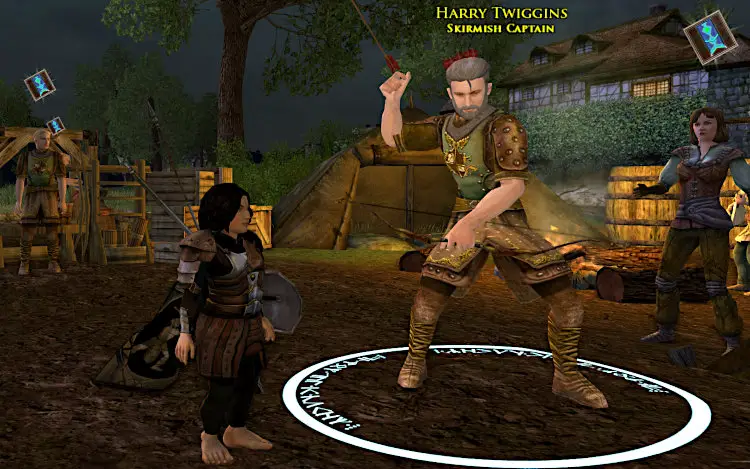
Speaking to the Trainers at Skirmish Camps you can acquire and equip different skills to your Skirmish Soldier. This includes which combat roles you want them to take on and which abilities you wish to train them in. As we’ll come to later, these folk are also the people to come to when designing your Soldier’s looks.
But first – practicalities, as Soldiers exist first to fight (or to aid those fighting).
Buy Skills
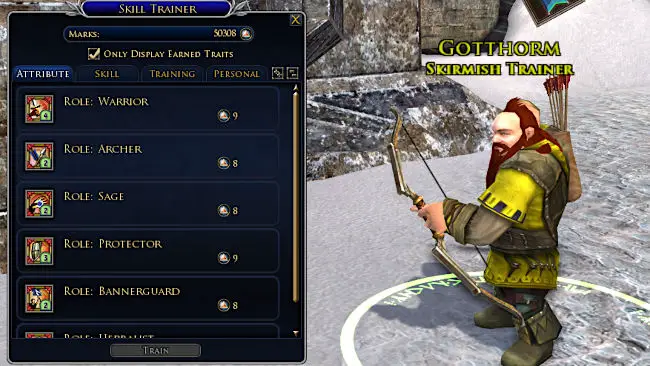
To buy skills for them, speak to a Skirmish Trainer and purchase them using  Marks.
All skills are grouped by combat role, so you can focus on acquiring or improving the relevant abilities for your Soldier.
Equip Skills
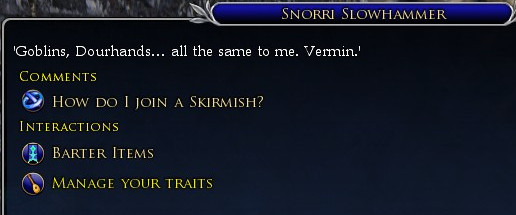
To equip, swap and generally manage your Soldier, speak to the Skirmish Captain and select “Manage Your Traits”.
Spend More to Increase Ability
This is one of those rare things in life where spending more actually gives you something better! In short, the more Marks you spend on your character’s abilities, the better they are at using them.
What is “Personal”?
Personal Traits relate to buffs and mitigations that apply to you while you’re in a Skirmish.
They can be useful to make yourself sturdier, or more potent in attacking, for example. Another aspect is that, if you are running with a Herbalist, healing companion, or a player-healer, then your incoming heals can be boosted.
For more on this, skip to Personal Traits.
Attributes
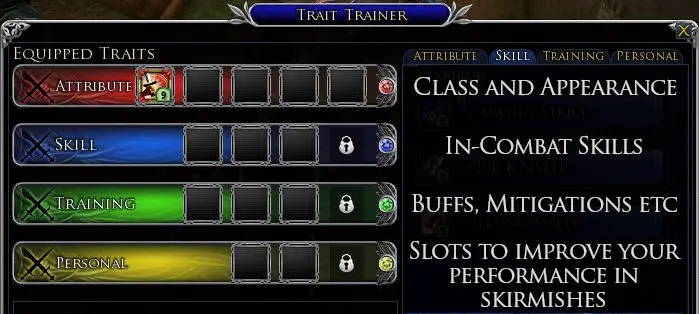
Attributes are combat roles you wish to train your Soldier in. I am going to call this your Soldier’s class from now on as I think that’s easier to understand. You can acquire more than one class, but for obvious reasons, you cannot equip more than one class at a time.
There are more slots, because you will use those to change your Soldier’s appearance (if you have Marks and  Medallions to spare, anyway).
Skills
On the Skill tab you’ll find specific abilities your Soldier can use in combat. They are grouped by class, allowing you to quickly see relevant skills. Use these to “patch” your weaknesses. So, for example, I use the Herbalist’s Nature’s Power skill to replenish power on my Guardian, as that can sometimes be an issue for me in longer fights.
Training
This relates to passive attributes that help your Soldier to perform better in combat. Examples are
- How well they use their armour to protect themselves.
- The strength of their combat abilities.
- How well they can block, parry or evade attacks.
All Basic Skills and Training Options
On larger screens, you’ll see I’ve split the Skills and Traits into tabs, in much the same way as in LOTRO. If you’re on a smaller screen, I haven’t figured out a good way of doing that yet.
Regardless of how you’re reading this, if you want to bypass all the options, you can go straight to Equipping Your Choices.
Protector
 Taunting Strike
Draws a single enemy’s attention.
Threatening RiposteA self-buff that aggros any mob that attacks them, keeping the aggro their way.
Threatening ShoutShouts to draw attention of nearby enemies.
Whirl of FuryHits all nearby enemies, making them more angry at the protector. This is a good thing.
Warrior
Carving StrikeCauses a bleed damage-over-time to a single enemy.
Forceful StrikeA strong attack against a single enemy.
Quick SweepA low-damage attack against nearby enemies.
Strong SweepA higher-level damaging attack against nearby enemies.
Archer
RefocusAllows the archer to replenish their Power gauge by a brief pause in attacks.
Deadly ShotA strong shot against a single enemy.
Distracting ShotA special kind of attack to reduce aggro against the Archer.
Pinpoint ShotA shot with a high chance of a critical hit. Bonus damage is inflicted when a hit is critical.
Bannerguard
Cry of the EnduringGrants an ally a temporary boost to Armour rating.
Potent StrikePowerful melée attack (against a single enemy, I think)
Inspiring ShoutA cry that grants a low amount of healing-over-time.
Summon the FoeA shout that draws aggro from nearby enemies.
Sage
Chilling WindsChills the air around them, slowing down enemy attacks for a time.
Weakening DraughtReduces enemy resistences (Tactical).
Tanglefoot(Crowd Control) Damages a foe, while also rooting them to the ground.
Oil of the Dragon’s RagePowerful AoE (tactical) attack.
Herbalist
Nature’s PowerRestores an ally’s Power (over time).
Refreshing HerbsA medium one-shot heal.
Strengthening DraughtBuffs an ally’s defences.
Nature’s CureGrants an ally a medium-strength heal-over-time.
For All Soldiers
Boundless MoraleGives your soldier more morale.
Boundless Power*Darth Sidious voice* Unlimiteeeed Poweeeeeer! I mean, *cough* gives your Skirmish Soldier more power. Yeah, that.
Resurgent PowerIncrease your soldier’s power regeneration.
Resurgent MoraleIncrease your soldier’s morale regeneration.
Defensive TrainingIncreases defensive manoeuvers: block, parry and evade ratings.
Parry TrainingYou’ll never guess what this is for? Oh, you did. Spoil sport.
Evasion TrainingIncrease evasion – the ability to avoid damage. I’m presuming this could be full or partial evasion. I’ll try and fact check that.
Practised CriticalIncreases your Soldier’s critical rating: the chance (and potency) of especially damaging hits. Does this affect heal critical, I wonder?
Tactical ResilienceIncreases Tactical Mitigation: reducing damage from non-physical attacks (think light, sorcery, lightning)
Physical ResilienceIncreases Physical Mitigation: reducing damage from physical attacks (If you were a Tater: boil ’em, mash ’em, stick ’em in a stew).
Resilient BodyIncreases the amount of morale your Soldier gains from being healed.
Boundless ResolveIncreases Morale and Power gauges.
Battle-field FinesseYou guessed it! Increases a soldier’s Finesse rating.
Strength of ResolveIncreases a Soldier’s Resistence rating.
For Specific Soldiers
Physical PotencyIncreases melée and ranged damage for Soldiers who use physical skills.
Archer, Warrior, Protector, Bannerguard
Tactical PotencyIncreases damage dealt and healing done for Soldiers using tactical skills.
Protector, Bannerguard, Sage, Herbalist
Extra and Heroic Skills
Once you reach a high enough level, you’ll be able to equip all the basic Skills. That’s because, by default there are only four. However, if you want to explore others then you can!
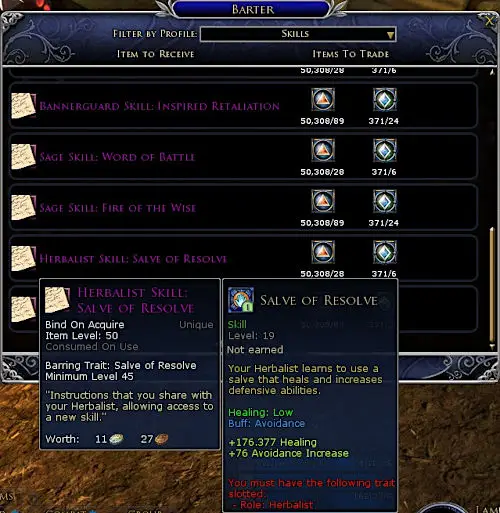
Speak again to the Skirmish Captain and choose the “barter” option. In exchange for a combination of Marks and Medallions, you can unlock further Skills and traits. There are also Ultimate skills, especially strong ones.
Click/tap the image to see an example.
Equipping Your Choices
Check Your Allowances
Once you have purchased the skills and attributes you want from the Skirmish Trainer, you need to speak to the Skirmish Captain and select Manage Your Traits. On the right, you’ll see the same tabs as you had in the purchasing window, but only listing those you have bought.
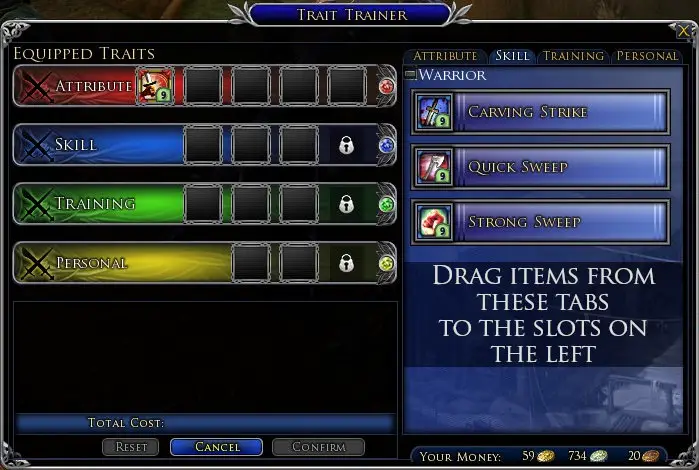
On the left are the slots you can fill with those purchases. The number of slots you have available depends on your character’s level. As you can see, my L54 Warden has one locked slot on Skill, Training and Personal. That last one we’ll get to shortly.
Filling the Slots
Choose Attributes first – especially which combat class you’re going to use. From then, you can only slot relevant skills and attributes to that class. So, you cannot have Light Armour Training on your Protector, for example. Not all skills/training have class limitations. I have my Herbalist running with some Evade Training sometimes – the less damage they take the more time they have to heal me!
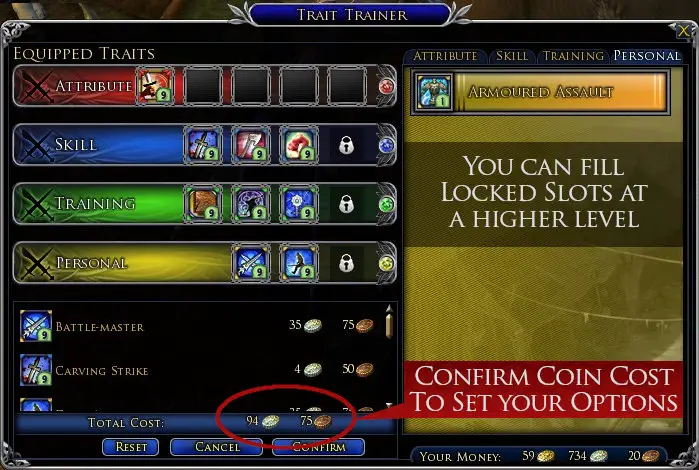
If you have purchased Skills or Traits, but cannot slot them, don’t worry. You can use them later when you have more slots, or to play around with the settings after running a few Skirmishes. You may also want to stock up on different class skills so you can switch from one class to another.
Soldier Ranks and Levels

Your Skirmish Soldier does not share the same level system that you do. Instead it has Ranks. As you purchase stronger and stronger abilities, their Rank increases. But it’s not as simple as matching your level to their rank.
In researching this ahead of Ill Omens, I found the Wiki had a great gauge for this. This is just for Nature’s Cure, but could apply to anything. Here are just the first few ranks:
How to Change Your Skirmish Soldier’s Appearance
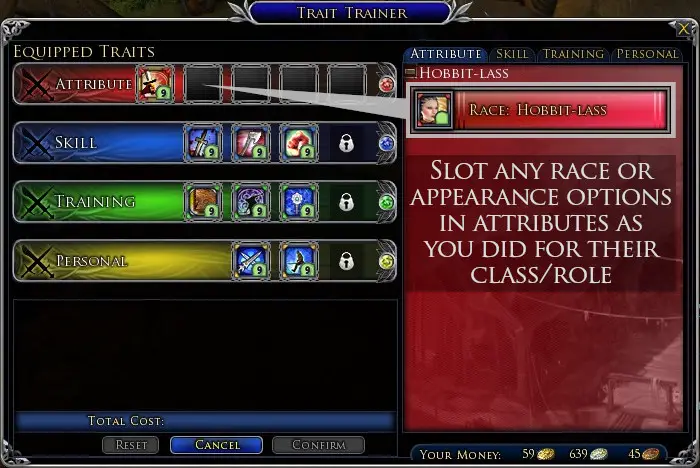
Appearance choices are slotted into the Attributes line of the Trait Trainer UI.
But first, let’s head to where you can acquire different appearances: the Cosmetics vendor in a Skirmish Camp.
There you’ll find a range of options allowing you to personalise your Skirmish Soldier, in exchange for Marks and Medallions.
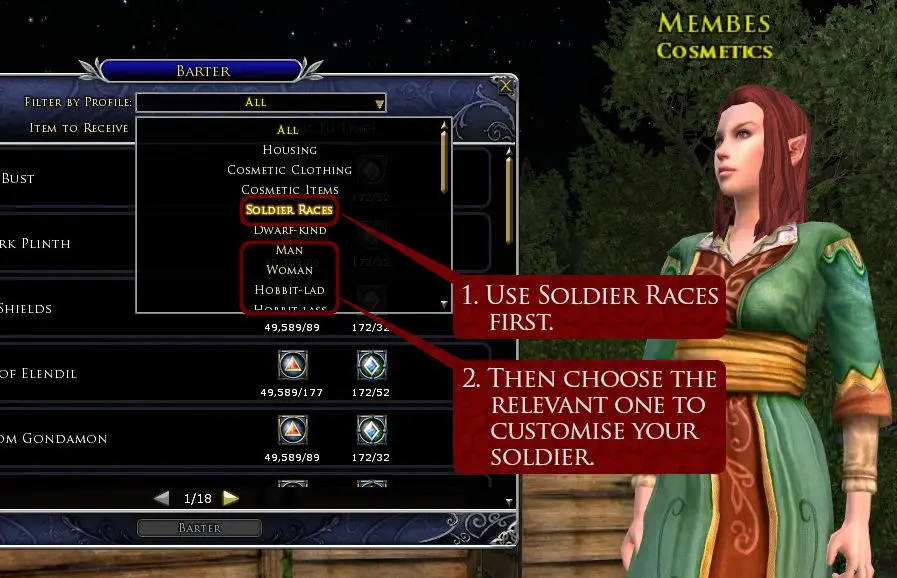
I’d suggest purchasing your race first, then moving onto the section in the vendor’s list that’s relevant for that race.
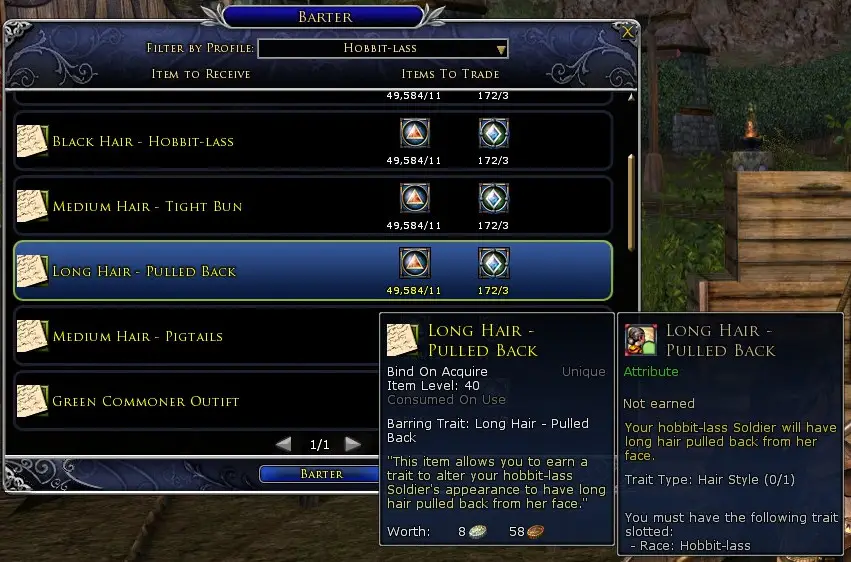
Slotting the Soldier Appearances
As I said earlier, these go into the Attributes section, along with your Soldier’s class. As nothing else goes on that row, it gives you plenty of scope to customise your assistant.
Full Soldier Cosmetics Guide!
I now have a much more detailed guide to customising the look of your Skirmish Soldier! This includes all races, outfits and colour options. Enjoy!
Personal Traits: Buff Yourself
As mentioned before, Personal Traits are applied to you while you are in a Skirmish. They follow a similar thread to those of your Skirmish Soldier. As such, you should choose ones appropriate for your class or trait tree – or to shore up any weaknesses.
I have listed all the traits in the next tab, but you can skip to ‘Earning Marks’ if you want. Examples are:
- Defences: Block, Parry, Evade and Armour Rating
- Mitigations: Physical and Tactical
- Mastery: Physical and Tactical
- Incoming Healing
- Attacks: Armour Penetration, Critical Rating, Finesse
Defensive WarfareIncreases your block, parry and evading ratings.
Strong BlockYep, increases your block rating.
Strong ResistancesIncreases your ability to resist some effects.
Defender’s BaneIncreases Finesse Rating.
Strong of WillBuffs your Tactical Mitigation.
Battle-MasterImproves your Critical Rating (applies to attacks and heals)
Fancy FootworkIncreases your Physical Mitigation.
InvigourationImproves how much your morale increases when you are healed.
Tactical ArtistryBuffs your Tactical Mastery rating – the amount non-physical attacks damage for, and how much morale your healing skills restore.
Piercing MightImproves your armour penetration. The amount you pierce your foes – not the other way around!
Armoured AssaultGuess what? Magically increases how strong your armour is. Only in Skirmishes, sadly.
Lead the WayIncreases your Physical Mastery: increases the amount of damage dealt for physical attacks (You have my sword, and my bow, and my axe. And now I’m weaponless.)
Duck AsideQuack! I mean, erm, improves your Evade Rating. *eyeshift*.
Swift ParryBecause parrying slowly is proven to be fatal.
Earning Marks
Just a brief note here: making your Skirmish Soldier better, stronger, faster will cost more and more Marks. And, as we saw when setting their appearance, Medallions too.
So how do you earn these?
- In Skirmishes: defeating certain enemies, and clearing “encounters”. Defeating the end boss and therefore completing the Skirmish will give you the greatest rewards.
- Skirmish Deeds: For example, clearing all the encounters from a Skirmish. This will be done by completing each one several times, as the Encounters are randomised.
- Skirmish “Slayer” Deeds: When Lieutenants are defeated, they progress their own deeds. As with other slayer deeds in Middle-Earth, there is a stage 1 and an “advanced” with different rewards for each. See the Lieutenant Deeds on the Wiki
- Landscape Deeds: Some general LOTRO Deeds also grant Marks as rewards.
- Steel Tokens: You can convert Steel Tokens to Marks during the LOTRO Anniversary
- Warbands: Ah, I had forgotten this one. Thanks LOTRO-Wiki! Yes, Warband Boxes may also drop Marks.
Landscape Soldier Tokens
The last thing to cover here is that you can use your Skirmish Soldier in open-world content (“Landscape”). To do so, you’ll need to acquire a Landscape Soldier Token.
Each token grants you 1 hour of a Soldier’s assistance, but you can summon and dismiss them whenever you want to. This can be handy if you’re in a particularly tricky area. Once you’ve dealt with the challenge, dismiss the Soldier and save your remaining time for later.
How to Get a Landscape Soldier Token
The Wiki’s link above shows that they are very expensive if purchased for Marks/Medallions. There are other ways:
- From the LOTRO Store for 100× LOTRO Points.
- The Mithril Coins trader at a Skirmish Camp.
- They can drop as Hobbit Gifts.
- Sometimes they are the weekly freebie code too.

Limitations
The key limitations of using your soldier this way are:
- Outdoors Landscape Use Only: You can’t use your soldier in certain places like Bree. You also cannot take them into indoor questing areas.
- Time Limited: you can only use them for the length of time your tokens allow. You can “save” up to five hours worth at a time, by using five tokens. But you can’t add more “air time” to that until you’re under the four hour mark.
- No Mounts: they can’t ride mounts, so don’t expect them to help you with Mounted Combat!
TL;DR Go Custom-build your LOTRO Skirmish Soldier and Dive in!
It turned out that covering the Skirmish Soldier was like “Skirmception”, each layer revealed more layers! But we’ve covered most things, at least! So now you can go ahead and build and customise your own Soldier. And don’t forget the two Skirmish-based events: Ill Omens and the Treasure Bugan Event.
Have fun in Middle-Earth, friends!